

 English
 русский
 Español
Content
Advantages Over Brushed Motor Drills
A lithium battery brushless cordless drill differs from a brushed motor drill primarily in how it generates rotational force. Below are the main advantages based on electrical and mechanical principles.
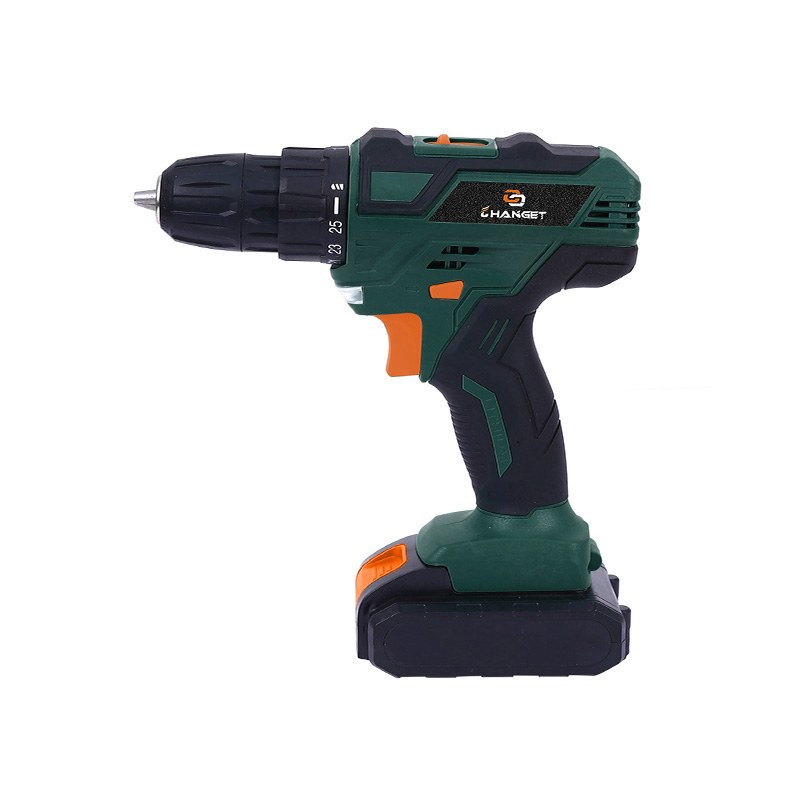
- Longer runtime per charge: Due to higher efficiency, a brushless drill completes approximately 30% to 50% more holes or screwdriving operations than a brushed drill using the same battery capacity. For example, a 2.0 Ah battery in a brushless drill may drive 250 drywall screws, while a brushed drill drives 170–190 screws.
- Extended tool lifespan: Brushless motors have no physical brushes to wear out. The primary failure point in brushed motors—carbon brush replacement every 50 to 100 hours of heavy use—does not exist. Brushless motor bearings and windings typically last 2,000 to 5,000 operating hours.
- Compact and lighter design: The stator winding arrangement allows a shorter motor length (approximately 30% reduction). A typical brushless drill weighs 0.9 to 1.3 kg, while a comparable brushed model weighs 1.3 to 1.8 kg.
- Electronic control features: Brushless motors include integrated circuitry for variable speed control, torque limiting, and overload protection. These features reduce the risk of gear damage when driving large fasteners.
Battery Life Expectations
Battery Chemistry and Capacity Basics
Lithium battery packs for cordless drills typically use lithium-ion cells with nominal voltages of 12V, 18V, or 20V. Capacities range from 1.5 Ah to 5.0 Ah for compact packs and up to 12.0 Ah for high-capacity packs. Battery life refers to two distinct measurements: runtime per charge and total lifespan measured in charge cycles.
Runtime per Charge
Runtime depends on workload intensity. Under light drilling (softwood, 5 mm diameter bits), an 18V brushless drill with a 2.0 Ah battery provides 45 to 60 minutes of continuous operation. Under heavy drilling (steel, 10 mm bits with continuous pressure), the runtime drops to 15 to 25 minutes. Driving screws into hardwood at 25 screws per minute yields 30 to 40 minutes of operation. Manufacturers typically publish no-load runtime (2 to 3 hours), which does not reflect real-world usage.
Cycle Life and Degradation
Lithium battery packs retain 80% of their original capacity after 300 to 500 full discharge cycles, based on cell manufacturer datasheets. A full cycle means discharging from 100% to 0% capacity. Partial discharges extend total lifespan—for example, 1,000 cycles of 50% depth-of-discharge provide similar total energy output. After 500 cycles, users notice reduced runtime: a drill that initially drove 250 screws may drive 200 screws with the same battery.
Factors That Shorten Battery Life
High ambient temperatures (above 35°C) accelerate chemical degradation by 20% per 10°C increase above 25°C
Storing batteries at 100% charge in warm environments (above 30°C) reduces cycle life by 30–40%
Repeated deep discharges below 10% capacity stresses cells, potentially causing voltage imbalance
Charging immediately after heavy use while the battery is hot (above 45°C) reduces long-term capacity
Suitability for Home and Professional Use
Home use assessment: A lithium battery brushless cordless drill is suitable for typical household tasks. These include assembling flat-pack furniture, hanging pictures, drilling into drywall or softwood, and driving deck screws. The lighter weight (0.9–1.3 kg) reduces arm fatigue during overhead tasks. Variable speed triggers with electronic braking provide control for delicate materials. However, the higher purchase cost ($80–150 for brushless vs. $40–70 for brushed) may exceed a casual user's budget. For drilling 5–10 holes per month, a brushed drill offers sufficient performance at a lower cost.
Professional use assessment: Many construction and renovation professionals use brushless drills daily. The extended runtime per charge (30–50% more than brushed) reduces battery swapping frequency on job sites. Higher torque output (50–80 Nm for brushless vs. 30–50 Nm for brushed in the same voltage class) allows driving larger fasteners into dense materials. Electronic clutch settings (typically 15–20 positions) provide repeatable torque control for sensitive applications like cabinet hinge installation. Dust and debris resistance (IP20 to IP54 ratings) meets typical job site conditions. However, in environments with extreme dust (concrete cutting) or moisture (roofing in rain), brushless electronics may fail brushed motors before.