

 English
 русский
 Español
In a cordless drill, speed and torque are inversely related because of how the motor and gearbox work. This is not a defect—it's a deliberate design trade-off.
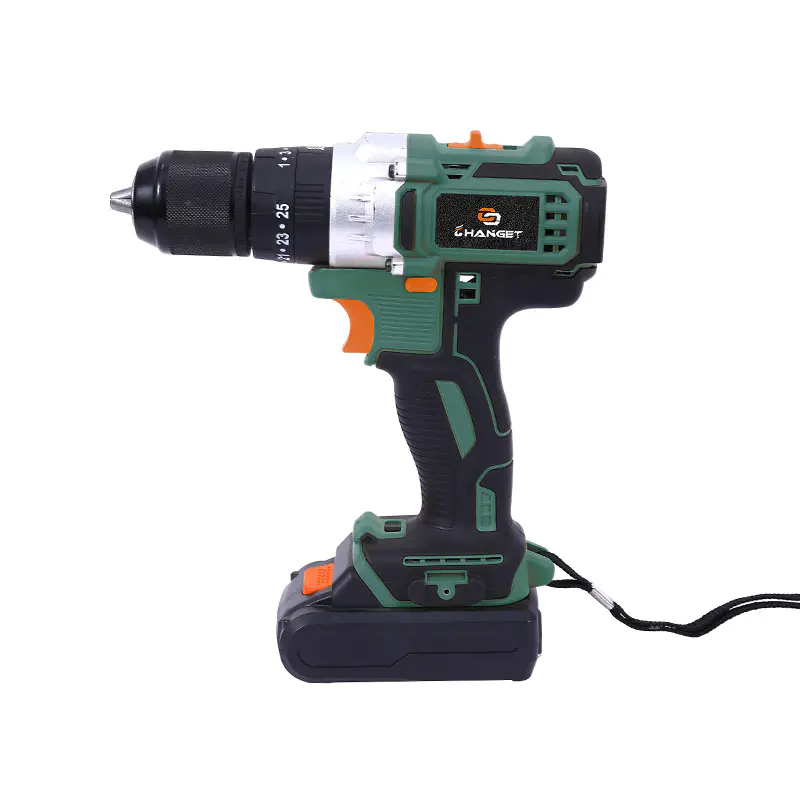
The gearbox ratio explains it all. A cordless drill has a two-speed or three-speed gearbox. In the low-speed setting, the gear ratio is high (e.g., 40:1 or 30:1). The motor spins fast (10,000–25,000 RPM), but the chuck spins slowly (400–600 RPM). Torque at the chuck is multiplied by the gear ratio, so you get high torque for driving large screws or drilling large-diameter holes. In the high-speed setting, the gear ratio is low (e.g., 15:1 or 10:1). The chuck spins fast (2,000–4,000 RPM), but torque is reduced proportionally. A typical 18V drill might produce 90 Nm of torque in low gear and 30 Nm in high gear (a 3:1 reduction). The product of speed × torque is approximately constant (minus frictional losses), so doubling the speed halves the available torque, and vice versa.
When should you use high speed? Use high speed for small-diameter drill bits (under 4 mm in steel, under 6 mm in wood), for drilling through thin materials where you want a clean entry and exit, and for jobs where you don't need much torque. For screw driving, you rarely want high speed because the clutch needs engagement time to stop at the correct depth. For large-diameter hole saws (50 mm or larger), use low speed—high speed would stall the drill or burn out the motor.
The brushless advantage. Brushless motors (which use electronic commutation instead of physical carbon brushes) maintain higher torque at high speeds than brushed motors. A brushed motor's torque drops off linearly as speed increases above its optimal point. A brushless motor's torque stays relatively flat across a wider speed range. So a brushless drill at 3,000 RPM might retain 70–80% of its low-speed torque, while a brushed motor of the same power might retain only 40–50%. That's why brushless drills feel better when drilling large holes in wood at high speed.
How do battery voltage and amp-hour rating affect drill performance?
Battery ratings are often misunderstood. Voltage and amp-hours (Ah) affect different aspects of performance.
- Voltage (12V vs. 18V vs. 20V vs. 40V): Higher voltage allows more power for the same current draw. An 18V drill at 20 amps produces 360 watts of input power. A 12V drill at 20 amps produces only 240 watts. In practice, a higher voltage drill will have higher maximum torque and faster drilling in metal and masonry. However, a lower voltage drill may be lighter and more compact for overhead work. Note that "20V max" is marketing jargon for the same cell chemistry as 18V nominal (lithium-ion cells are 3.6V nominal, 4.2V fully charged; 5 cells in series give 18V nominal, 21V fully charged). A 20V max drill and an 18V drill are electrically the same—the 20V refers to the peak voltage, not the working voltage. A true 40V drill (10 cells in series) delivers about double the power capability.
- Amp-hour rating (2Ah, 4Ah, 5Ah, 8Ah, 12Ah): This is the battery's energy capacity, like the size of a gas tank. A 4Ah battery holds twice the energy of a 2Ah battery of the same voltage. That means longer run time between charges—but not necessarily more power. Under heavy load (drilling large holes, using a hole saw), a larger Ah battery will maintain higher voltage for longer because it has more parallel cells or larger cells, reducing internal resistance. A 5Ah battery might deliver 10–15% more power at the drill motor than a 2Ah battery during the first minute of heavy use, simply because it doesn't sag as much. Under light loads (driving small screws), you won't notice a difference except in run time.
- Battery cell type (18650 vs. 21700): Older and smaller batteries use 18650 cells (18 mm diameter, 65 mm tall). Newer high-capacity batteries (often 4Ah and above) use 21700 cells (21 mm, 70 mm). 21700 cells have lower internal resistance and better heat dissipation. In actual performance, a 5Ah battery with 21700 cells will deliver more power to the motor under heavy load than a 5Ah battery with 18650 cells, especially as the battery gets hot. Some professional-grade 18V/20V batteries now use 21700 cells exclusively for their 5Ah and larger packs.
What do the clutch settings actually mean on a cordless drill?
The clutch is a numbered collar behind the chuck. It limits how much torque the drill applies before it releases (slips or stops driving). The numbers (typically 1–15, plus a drill bit symbol) correspond to different torque limits.
How the clutch works. Inside the drill, a spring pushes a set of steel balls against a cam ring. When the torque at the chuck exceeds the spring force, the balls ride up the cam ramps, and the chuck disengages from the motor. You hear a "ratcheting" sound. This prevents the screw from over-driving (sinking too deep or stripping the hole) and prevents the drill from twisting your wrist.
What each number range is for.
- Settings 1–4 (low torque): For very small screws into soft materials (like 1.5 mm screws into plastic electronics cases, or small hinges into soft pine). The drill will stop driving almost the moment the screw head touches the surface.
- Settings 5–9 (medium torque): For medium screws into wood (3 mm screws into softwood, 2–3 mm screws into hardwood, or small 4 mm screws into drywall anchors).
- Settings 10–15 (high torque): For large screws (5–6 mm lag bolts into softwood, driving screws into hardwood where the clutch trips late). Most drywall screw driving uses setting 10–12.
- Drill symbol (drill bit): This is not a numbered setting. It disengages the clutch entirely, so the drill applies full motor torque until you release the trigger. Use this for drilling holes, not for driving screws.